For years, businesses measured search visibility through a familiar set of indicators: keyword rankings, organic traffic, backlinks and conversions. Those metrics remain important, but the way customers discover and evaluate companies is changing.
A buyer looking for an enterprise technology partner may still begin with Google. Increasingly, however, the same buyer may ask ChatGPT to suggest providers, use Gemini to compare companies, consult Perplexity for supporting sources, or rely on an AI-generated overview before visiting a website.
For enterprises, this creates a new visibility challenge: ranking on a search engine does not necessarily mean being understood, cited or recommended by an AI system.
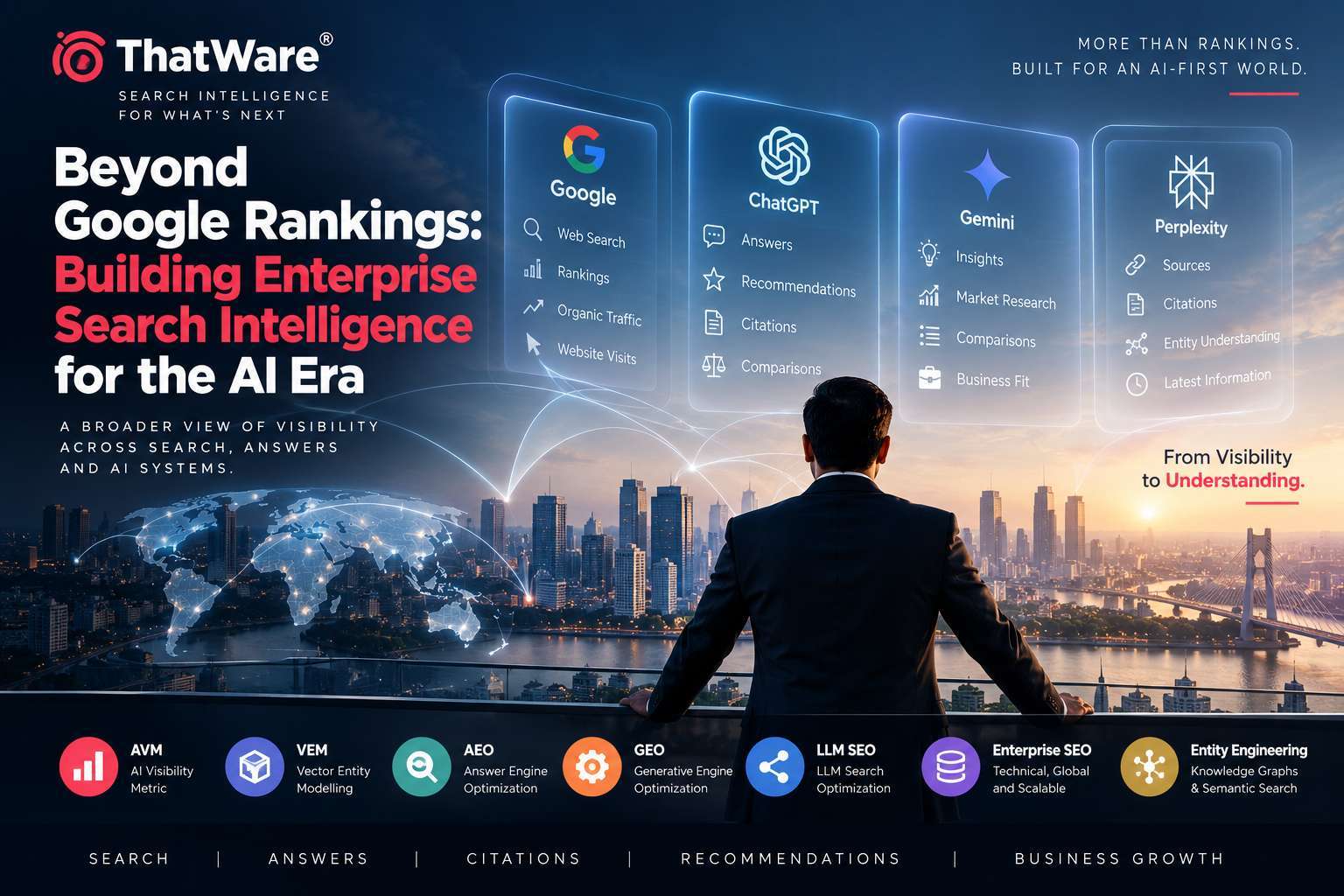
Indian search intelligence company ThatWare is building its enterprise search strategy around this changing discovery journey, bringing together traditional and technical SEO with AI Search Optimization, Answer Engine Optimization (AEO), Generative Engine Optimization (GEO), LLM SEO, AI visibility measurement, entity engineering and knowledge-graph intelligence.
The objective is not to replace SEO. It is to expand what search visibility means in an AI-first environment.
From Search Rankings to AI Visibility
Traditional search optimization largely answers questions such as: Where does a website rank? How much organic traffic does it receive? Which keywords generate enquiries?
AI-led discovery introduces another set of questions.
When a potential customer asks an AI assistant for the best providers in a category, is the company mentioned? Is it accurately described? Is it cited? How prominently does it appear compared with competitors? And does the AI system understand enough about the company to recommend it in a commercial or comparative context?
ThatWare has been developing AVM, or AI Visibility Metric, as a measurement framework for this layer of search.
Rather than treating an isolated AI response as a permanent ranking, AVM examines multiple dimensions of visibility, including presence, citations, authority, consistency and position. The purpose is to help organizations identify where their brands are visible across AI-led discovery environments and where competitors may be gaining an advantage.
“Businesses are beginning to realise that a first-page Google position and strong AI visibility are not necessarily the same thing,” said Dr. Tuhin Banik, Founder and CEO of ThatWare. “The next challenge is understanding whether AI systems can identify your organization correctly, connect it with the right expertise, find sufficient supporting evidence and consider it relevant when a customer asks a decision-stage question.”
Why Entity Understanding Matters
Visibility, however, is only one part of the problem.
A company may have thousands of indexed pages and still be represented inconsistently across its website, media coverage, directories, reviews, executive profiles and third-party sources.
ThatWare addresses this layer through VEM, or Vector Entity Modelling.
VEM focuses on how clearly a business exists as a machine-understandable entity: who it is, what it offers, which markets it serves, which people and products are connected to it, what expertise it possesses, and whether those relationships remain consistent across the wider information ecosystem.
For large organizations, this becomes particularly important. Enterprises frequently operate across multiple countries, languages, websites, product lines and business units. Their digital identity can become fragmented long before an AI system attempts to summarize it.
ThatWare therefore connects entity engineering with semantic architecture, structured data, knowledge graphs, authoritative citations and AI-readable information to create a more coherent digital knowledge footprint.
The distinction is intentionally straightforward:
AVM measures visibility. VEM strengthens understanding. AEO, GEO and LLM SEO provide the optimization layer.
Enterprise Search Is Becoming a Governance Problem
The shift is particularly significant for large businesses.
Enterprise SEO has traditionally involved challenges such as managing thousands of URLs, international websites, migrations, technical architecture, internal linking, content governance and large keyword portfolios.
AI discovery adds further complexity.
Organizations now need to consider how products, executives, services and corporate facts are interpreted across multiple AI systems; whether AI-generated answers contain outdated information; which competitors are being recommended; which external sources influence those recommendations; and whether the organization has sufficient evidence to support commercial claims.
That changes AI search from a content experiment into a broader enterprise visibility and governance issue.
ThatWare's enterprise model consequently combines large-scale technical SEO with AI visibility audits, competitor intelligence, citation analysis, entity architecture, AEO, GEO, LLM discoverability and semantic search engineering.
The company sees particular relevance in areas such as enterprise AI visibility audits, competitor AI visibility analysis, AI citation tracking, AI share of voice, LLM visibility monitoring and multi-market AI search intelligence.
These are emerging disciplines rather than replacements for conventional search metrics. Traffic, rankings, leads and revenue remain fundamental. AI visibility adds another layer for understanding how a company is represented before a customer reaches its website.
Measuring AI Search Without Treating It as a Fixed Ranking
One challenge facing the industry is measurement itself.
AI-generated answers can change depending on the model, prompt, geography, context and time of testing. A brand appearing first in one response cannot reasonably be described as permanently ranking first across AI search.
ThatWare believes the next stage of the industry will therefore require greater methodological transparency.
Organizations evaluating AI visibility should increasingly ask how many prompts were tested, which AI platforms were included, how often tests were repeated, which countries and languages were covered, how citations were assessed and how competitor visibility was benchmarked.
This is also why ThatWare is developing its search intelligence approach around measurement and validation rather than relying solely on individual screenshots of AI-generated recommendations.
India’s Opportunity in the Next Search Economy
India has become one of the world's largest digital markets while simultaneously producing technology companies serving global customers.
That creates an opportunity for Indian enterprises to participate early in the transition from conventional search optimization to AI-led discovery.
For Banik, the opportunity is not about declaring traditional SEO obsolete.
“Google rankings, technical SEO, content quality and authority remain fundamental,” he said. “What is changing is the number of systems standing between a business and its customer. Search is becoming a combination of rankings, answers, citations, recommendations and machine understanding. Businesses need visibility across that entire journey.”
ThatWare's work across AI Search Optimization, AEO, GEO, LLM SEO, AVM and Vector Entity Modelling reflects that broader direction.
The company is also extending the conversation beyond simple citation counts. Banik is scheduled to speak at BrightonSEO in October 2026 on “It’s Not Enough to be Cited: How AI Systems Draw Conclusions About Brands,” examining how AI systems move from finding information about an organization to forming broader conclusions about the brand.
As AI increasingly participates in commercial discovery, the larger question for enterprises may therefore change.
It will no longer be only:
“Where do we rank?”
It may increasingly become:
“When customers ask AI about our market, does it understand who we are—and are we part of the answer?”
About ThatWare
ThatWare is an India-founded search intelligence company working across advanced SEO, enterprise SEO, AI Search Optimization, Answer Engine Optimization (AEO), Generative Engine Optimization (GEO), LLM SEO, semantic engineering, entity intelligence and AI visibility measurement. Its research ecosystem includes AVM (AI Visibility Metric) and VEM (Vector Entity Modelling), designed to help organizations measure AI-search presence and strengthen machine understanding of their brands.